

Good vision is essential for reading. If words on the page are blurred or doubled, they become very difficult to read. In some cases, reading difficulties can be caused by vision problems such as long-sightedness, astigmatism or problems coordinating the eyes. When someone struggles with reading, the first step should be to book an eye examination with an optometrist. The optometrist will advise if any glasses or other forms of treatment are required.
There are a group of people who will still struggle with reading despite having perfect vision.
Dyslexia and Reading Difficulties
In some cases, reading difficulties are caused by “dyslexia”, and children with this condition should be assessed by a SENCO or Educational Psychologist and given appropriate support.
Visual Stress / Meares-Irlen Syndrome.
Visual Stress is a distinct condition to Dyslexia. Those with Visual Stress report that words appear to move, wobble or flicker when they read for any length of time, or that they perceive colours or other visual distortions in the background to the text. These symptoms can affect reading fluency and cause eye strain, headaches or even migraines. If looking at text is not comfortable, children will tend to avoid reading, which in turn can slow the development of reading skills.
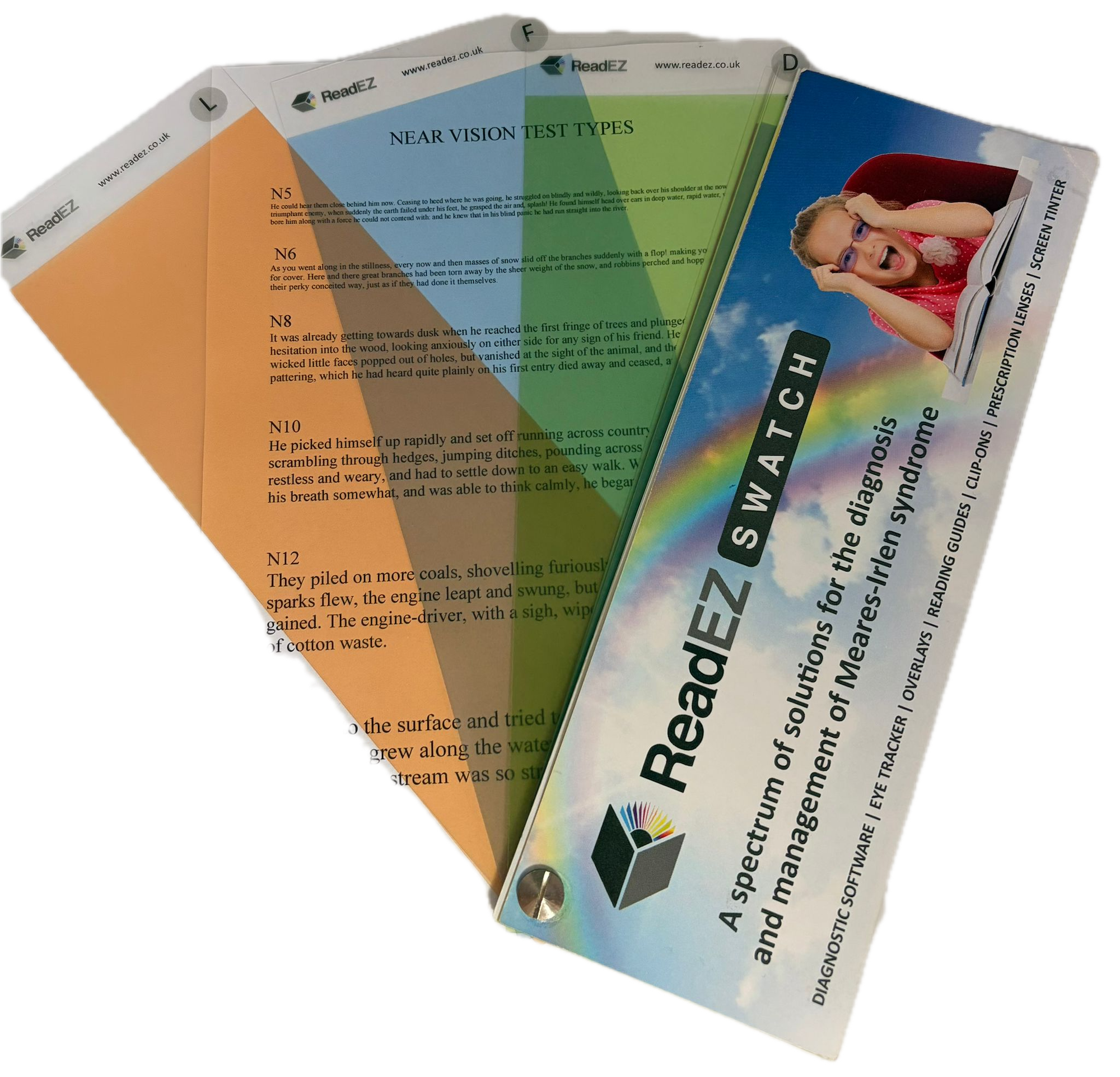
The condition is thought to be caused by overactivity of cells in the part of the brain that process information from the eyes. For reasons that are not well understood, the symptoms of Visual Stress can often be reduced by changing the background colour of the text using an overlay or coloured lenses. The colour which minimises symptoms varies from person to person hence a range of colours are required. In summary, it may well be the contrast and striped pattern effect of black text on a white background which is causing the disturbances of the print which these people experience.
Background of Visual Stress
In 1980, Olive Meares, a New Zealand teacher and reading specialist noticed that some pupils with reading difficulties found it easier to read text that was printed on coloured paper.
At around the same time, educational psychologist, Helen Irlen recognised a similar phenomenon with a subgroup of children. A coloured overlay was placed over text, which dramatically improved reading ability for some children. Irlen found a variation in reading ability with different coloured overlays. This is now referred to as Meares-Irlen Syndrome.
Approximately 20% of the population experience discomfort when looking at certain patterns, including rows of text.
A protocol has been developed for use of the overlays where two identical passages of “easy to read”, randomly ordered words are placed side by side and different coloured overlays are placed over the text. The reader chooses which overlay (or none) improves reading and by a process of elimination, the reader selects a colour.
This protocol has been standardised by the development of the ReadEZ system which was developed at City University London by Professor David Thomson. He has conducted research in this area and is convinced that a significant proportion of the population can be helped to read more comfortably using coloured overlays and lenses.
How Gray Opticians in Rugby can help with ReadEZ
If you are concerned about problems with reading, firstly book in for a sight test. If no issues are identified, we can book you in for a ReadEZ assessment (We are a recognised test centre in Rugby). We will provide written reports for you and the school and supply coloured overlays in the chosen colour.
- The sight test may be paid for by the NHS, if the person is in an eligible group.
- ReadEZ assessment charge £75.

ReadEZ at Gray Opticians Rugby
Please be aware that with this type of assessment, we can neither guarantee that they will benefit from the use of coloured filters nor that their reading ability will improve.

Images are used for illustrative purposes only. Thank you.